

Why the small shield was often superior to the large one
Two shields, two eras, one pattern: In the Middle Ages, there was the large war shield for open battle and the small buckler for unexpected attacks in everyday life. Today, this pattern is repeated with the police shield and QUICKSHIELD. But while the war shield has continuously survived as a police shield to this day, the buckler disappeared completely for about 1000 years until QUICKSHIELD resumed its role: inconspicuous, de-escalating, but immediately ready for use in an emergency.
The historical comparison: Buckler vs. War Shield
When thinking of medieval shields, most people envision the large war shield: the Norman Kite Shield, the knight's Heater Shield, and later the massive pavises of mercenaries. These shields were built to protect the entire body, to withstand in closed formations, and to resist enemy arrows, spears, and sword blows in open field battles. They were large, heavy, and intended for organized, visible combat. Anyone carrying a war shield unequivocally signaled readiness for battle. It couldn't be hidden, and usually, there was no desire to hide it.
The buckler was the exact opposite. A small, round fist shield, often no larger than a plate, was held by a handle rather than fixed to the forearm. It was lightweight, extremely mobile, and primarily carried in civilian daily life: by travelers, merchants, craftsmen, and ordinary citizens who needed to protect themselves against assaults, knife attacks, or street brawls. Unlike the war shield, the buckler was not intended for announced battles but for the moment no one sees coming: the sudden ambush, the unexpected close-range attack, for which there was no time for preparation or armor. Historical fencing manuals such as Manuscript I.33 from the early 14th century show the buckler in combination with the sword as a system for precisely this purpose: fast, situational self-defense against the unforeseen, not battlefield tactics.
The war shield was a statement. It was carried openly, it was part of an armor, a uniform, a recognizable military role. The buckler, on the other hand, could hang on the belt, inconspicuously, almost casually. Only in the moment of threat was it taken in hand and actively used, for defense, for counterattacks, sometimes also for actively pushing back the attacker. A large shield escalates a situation simply by its presence. A buckler, however, could be carried discreetly without provoking a confrontation, but be ready for use in fractions of a second in an emergency. It was the tool for the ordinary citizen, not for the soldier in formation.
The modern comparison: QUICKSHIELD vs. Police Shield
The same dichotomy can be observed today in a unique, modern pair of shields: QUICKSHIELD and the police shield. The police shield, as used by riot police units, in object protection, or by riot control units, is large, heavy, and intended for collective, visible, and often frontal use. It protects the entire body, is used in closed formations, and is a clear sign of state authority and readiness for action. No one carries a police shield concealed; that is not its purpose. It is used when a confrontation is foreseeable and a unit can specifically prepare for it.
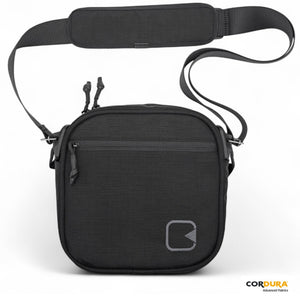
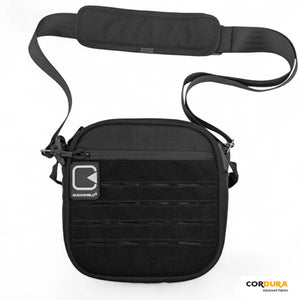
QUICKSHIELD is designed in precisely the opposite way. It is small, lightweight, and developed for civilian everyday life, not for formations, but for the individual. Stored in its bag, it appears inconspicuous and thus has a de-escalating effect: no one sees it, it provokes nothing, it does not change a social situation merely by its presence. But if needed, it can be made ready for use in a very short time. So while the police shield is the answer to the foreseeable, announced confrontation, QUICKSHIELD is the answer to the unforeseen attack, the situation that develops in seconds out of nowhere, without warning, without time to evade or prepare.
QUICKSHIELD takes on the role of the buckler
These two comparisons, buckler vs. war shield then and QUICKSHIELD vs. police shield today, clearly follow the same pattern. But the truly remarkable point lies elsewhere: in the continuity of one side and the break on the other.
The war shield as a concept has never truly disappeared. It has merely evolved and continues to exist uninterruptedly in the institutional sector to this day, most recently as a police shield for emergency forces. The buckler, on the other hand, almost completely disappeared from civilian everyday life after the end of the fencing manual tradition. For centuries, there was simply no modern equivalent, no small, everyday, concealed shield for an individual. This gap existed until QUICKSHIELD was invented.
Only with QUICKSHIELD does the buckler resume its historical role, precisely in relation to the police shield, as it once did to the war shield: The police shield is the direct, uninterrupted descendant of the war shield. QUICKSHIELD is the continuation of the buckler, only now revived after a gap of about 1000 years. One principle was continuously maintained institutionally, the other had to be reinvented as a civilian protection concept before it could reassume this role.
The buckler was never a shield for battle. It was a shield for everyday life, for the moment when you least expect it and most urgently need it. Precisely this principle is now carried into the present by QUICKSHIELD, while the large, visible shield remains where it historically always was: with those whose task it is to maintain order openly and in formation.